Faith
Mission-trip coordination: keeping travelers, documents, and responsibilities organized
A practical coordination worksheet for traveler readiness, private document follow-up, and the responsibilities around departure.

A mission-trip plan has several audiences. Travelers need to know what to do next. Coordinators need to know what is unresolved. Hosts need the details that affect the work on the ground. Sending one large spreadsheet to all three groups can make each job harder.
Start by separating the shared plan from restricted traveler information. The approach below uses a fictional eight-person, five-day trip. It is an organizational example, not destination-specific entry, safeguarding, medical, or legal advice. Confirm applicable requirements with your organization, hosts, providers, and the relevant authorities.
Track readiness rather than copying every document
Create a readiness checklist that records the requirement, the responsible person, its status, and the next follow-up. A status such as “review requested” can often answer a planning question without placing the underlying document in a broadly shared file.
The FTC’s Start with Security guidance recommends limiting the personal information an organization collects and restricting access to what people need for their work. For a trip team, that means deciding why each requested item is necessary before collecting it—not adding sensitive fields simply because a form makes it possible.
Do not put passport numbers, health details, or copies of identification into a public itinerary. Choose an appropriately restricted process for any sensitive documents your organization requires, and decide how long they will be retained.
A worked readiness example
Our fictional team assigns one coordinator to participant follow-up and another to transport. The shared coordination worksheet contains statuses, not document contents.
| Item | Responsible person | Status | Next action | Who needs access |
|---|---|---|---|---|
| Traveler details | Each traveler | 6 of 8 reviewed | Follow up with remaining travelers | Trip coordinator |
| Required document review | Designated reviewer | In progress | Confirm outstanding requirements | Authorized reviewer |
| Arrival transport | Transport lead | Provider contacted | Confirm pickup instructions | Logistics team |
| Rooming preferences | Accommodation lead | Requests collected | Reconcile with available rooms | Accommodation team |
| Host briefing | Team lead | Draft prepared | Review responsibilities with host | Traveling team |
“6 of 8 reviewed” is a fictional example count. Define “reviewed” before using the status: perhaps it means the traveler checked their own details and the designated reviewer completed the organization’s process. Do not let a convenient label imply an approval that has not happened.
Give every handoff an owner
A useful task reads: “Transport lead confirms the pickup meeting point with the provider by Tuesday.” It identifies an action, a person, a counterpart, and a deadline. “Airport” identifies only a topic.
When a responsibility changes, record the new owner and tell both people. For example, if the accommodation lead cannot travel, the replacement needs the provider contact and the list of unresolved questions, not only a rooming file.
Keep the on-trip contact sheet short enough to use under time pressure. Include roles and appropriate contact methods. Decide which details can be shared with the whole group and which should remain with the coordinator.
Prepare the traveler version
Give travelers a concise itinerary with confirmed meeting points, local dates and times, accommodation details appropriate to share, and the next action. Mark unresolved arrangements clearly. A provider confirmation belongs in the coordinator’s records; an assumption should not appear as a confirmed instruction.
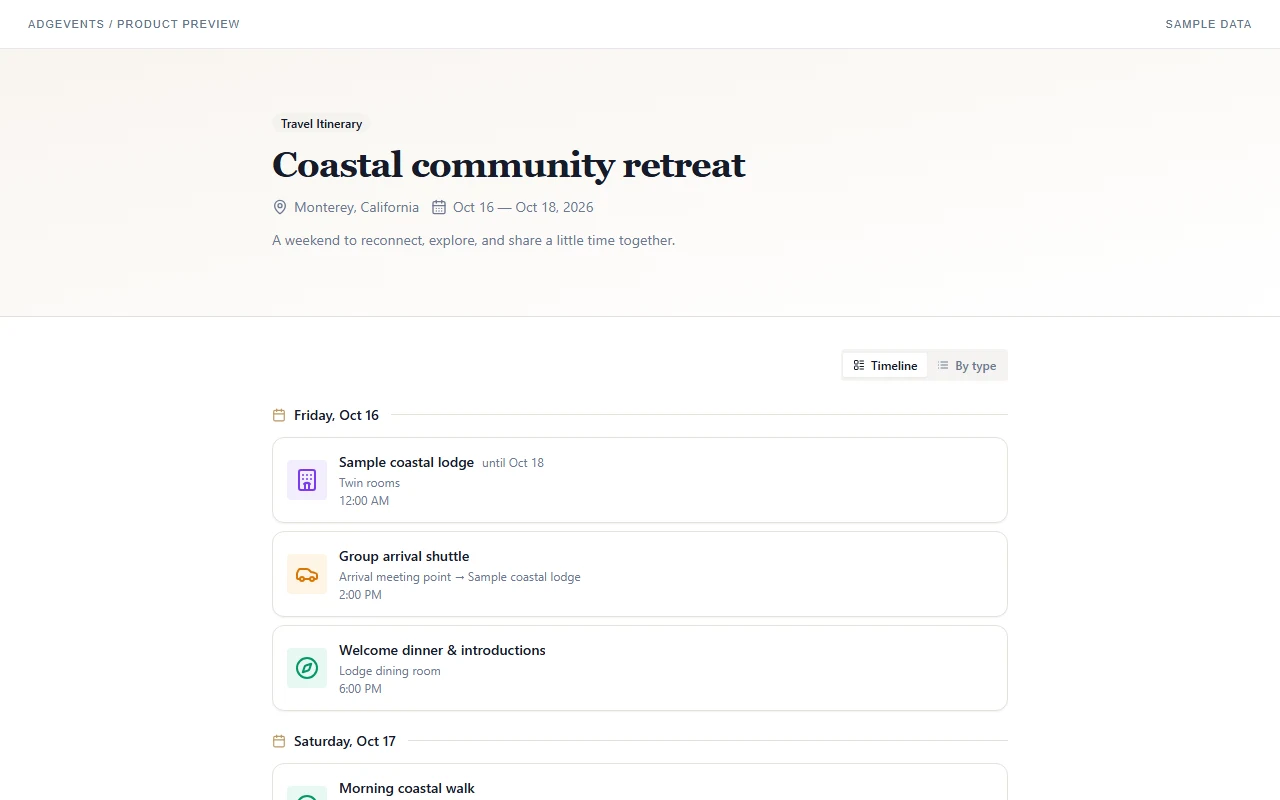
This is the actual ADGEvents itinerary interface populated with sample records. The itinerary presents the arrangements entered by the organizer; it is not a live booking confirmation from an airline or hotel.
Copy the departure review checklist
- Each required item has a named reviewer and a clear completion definition.
- Sensitive information is restricted to authorized people.
- Remaining traveler questions have a next action and due date.
- Hosts and providers have confirmed the details relevant to them.
- The shared itinerary identifies which arrangements are still provisional.
- Travelers know the meeting point and the appropriate coordinator contact.
- A backup owner has the information needed for each critical handoff.
- Retention and deletion responsibilities are assigned after the trip.
Download the coordination worksheet. Adapt its rows to the requirements you have verified. See the faith product page for the supported planning workflows and the Trust Center for the platform’s published security information.