Travel
How to build a group itinerary people can actually use
Turn the organizer’s detailed plan into a readable traveler itinerary, with a sample arrival day and a review checklist.

An organizer’s itinerary and a traveler’s itinerary do different jobs. The organizer may need supplier references, unresolved requests, and internal responsibilities. A traveler usually begins with a simpler question: “Where should I be next?”
Write the traveler version around that question. Keep the information needed to act near each activity, and give internal coordination its own place. The example here is a fictional three-day coastal retreat, not a bookable trip or a customer story.
Begin with the day, then the next action
Use one section per day with a clear date. Within each section, make the start time, activity, and meeting point easy to find. Explain whether a time is a departure time, an arrival window, or the beginning of an activity.
“Shuttle at 2” leaves too much to interpretation. “Friday, October 16: meet at the marked group pickup point at 1:45 p.m.; shuttle departs at 2:00 p.m.” is a more usable instruction once the provider has confirmed it.
For trips across time zones, state which local time applies at each location. Do not silently use the organizer’s home time zone for a destination activity. Check the actual arrangements rather than calculating changes from memory.
A worked arrival-day example
| Local time | What happens | Where to go | What travelers need to know |
|---|---|---|---|
| 1:45 p.m. | Meet the group | Confirmed arrival meeting point | Find the trip coordinator |
| 2:00 p.m. | Shuttle departs | Provider pickup area | Have your bag ready before departure |
| 3:00 p.m. | Accommodation arrival | Sample coastal lodge | Coordinator explains the check-in process |
| 5:45 p.m. | Meet for dinner | Lodge lobby | Allow time to walk to the dining room |
| 6:00 p.m. | Welcome dinner | Lodge dining room | Introductions and a preview of tomorrow |
These sample timings are illustrative. They are not claims about transfer duration, hotel check-in policy, or a particular destination. Replace them with confirmed details.
The fifteen-minute meeting window before departure is an intentional planning choice. Make choices like this explicit instead of leaving travelers to discover them in a chat message.
Make the page readable on a phone
Put the most useful information first. A paragraph describing the destination should not bury the next meeting point. Use short headings, ordinary language, and links whose text tells people where they go.
The W3C page-structure guidance explains how headings communicate organization and support navigation. For an itinerary, a heading such as “Friday: arrival and welcome dinner” provides more context than “Day one details.”
Do a small practical review: open the itinerary on a phone, hand it to someone who did not create it, and ask them to identify the next meeting point. Use their questions to improve the instructions. That is a usability check, not proof of a conversion result or a guarantee that every participant will have the same needs.
Give changes a clear path
Choose who can confirm a change and who communicates it. If dinner moves, update the primary itinerary before circulating the new instruction. A message should identify what changed, when the change takes effect, and where the current plan lives.
For a printed or downloaded version, include a version date and explain how travelers can get current information. A saved copy cannot update itself. Do not describe a static export as live.
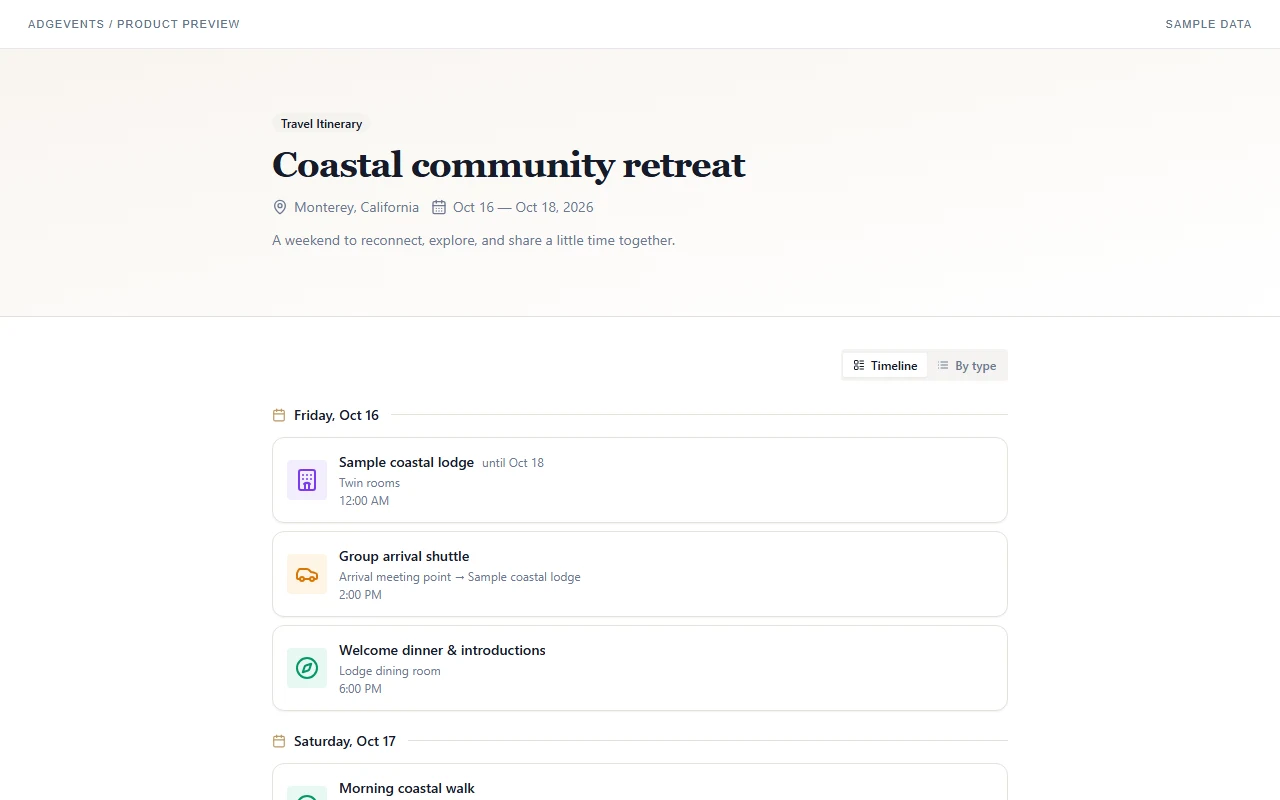
The actual ADGEvents public itinerary groups entered arrangements into a timeline. This capture contains sample data. The platform coordinates details you record; it does not currently sell live flight or hotel inventory.
Copy the traveler-readiness checklist
- Every day has a date and descriptive heading.
- Meeting time and departure time are distinguished.
- Each timed activity identifies the applicable local time.
- Locations and pickup instructions match provider confirmations.
- Unconfirmed plans are labeled clearly.
- Travelers have an appropriate coordinator contact.
- Sensitive traveler records are absent from the public itinerary.
- The change process is clear to the team.
- Someone outside the planning team has reviewed the phone version.
Download the itinerary worksheet, then explore group travel coordination in ADGEvents. For the rooming handoff, continue with rooming lists without spreadsheet confusion.